

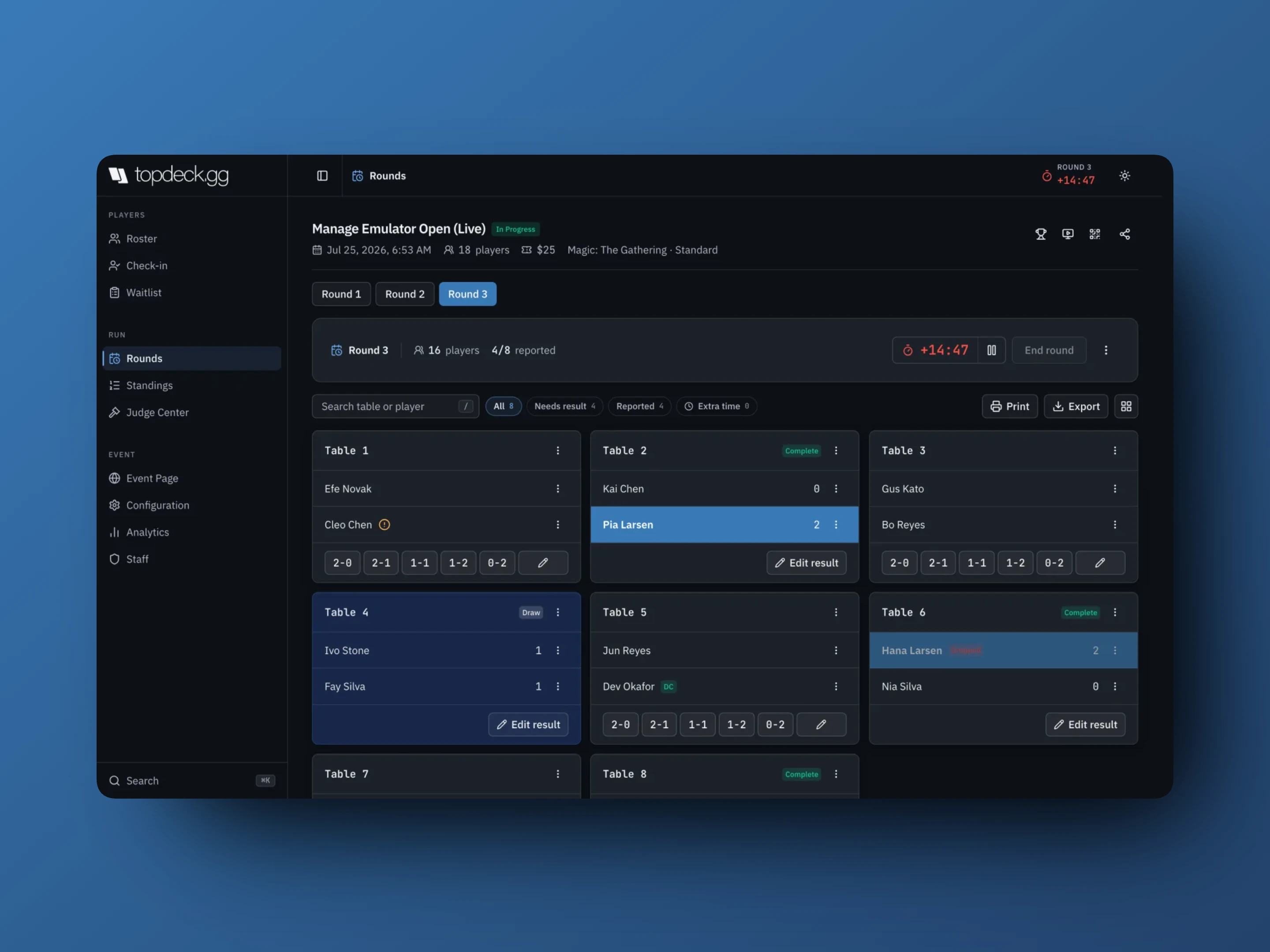
Rounds is the event-day control room. Pairings, result entry, the clock, table actions, printing, and exports all live on this one page.
Before you pair round one
- Finish Check-in and drop the no-shows.
- Confirm the active players on Roster.
- Check Round Duration, Best Of, Points mode, and Tiebreakers in Configuration.
- Open Rounds.
Round one shows a Before you pair this round panel when something looks unfinished:
- N registered players aren't checked in — they'll be paired anyway.
- N pending invites haven't registered — resolve or they won't be paired.
- N teams are missing players and will sit out this round.
Fix it jumps to the section that resolves the warning. Pair anyway accepts it and pairs. Round one has these guards because an accidental inclusion is hardest to unwind after play starts.
Pair a round
Select New round and choose a pairing method.
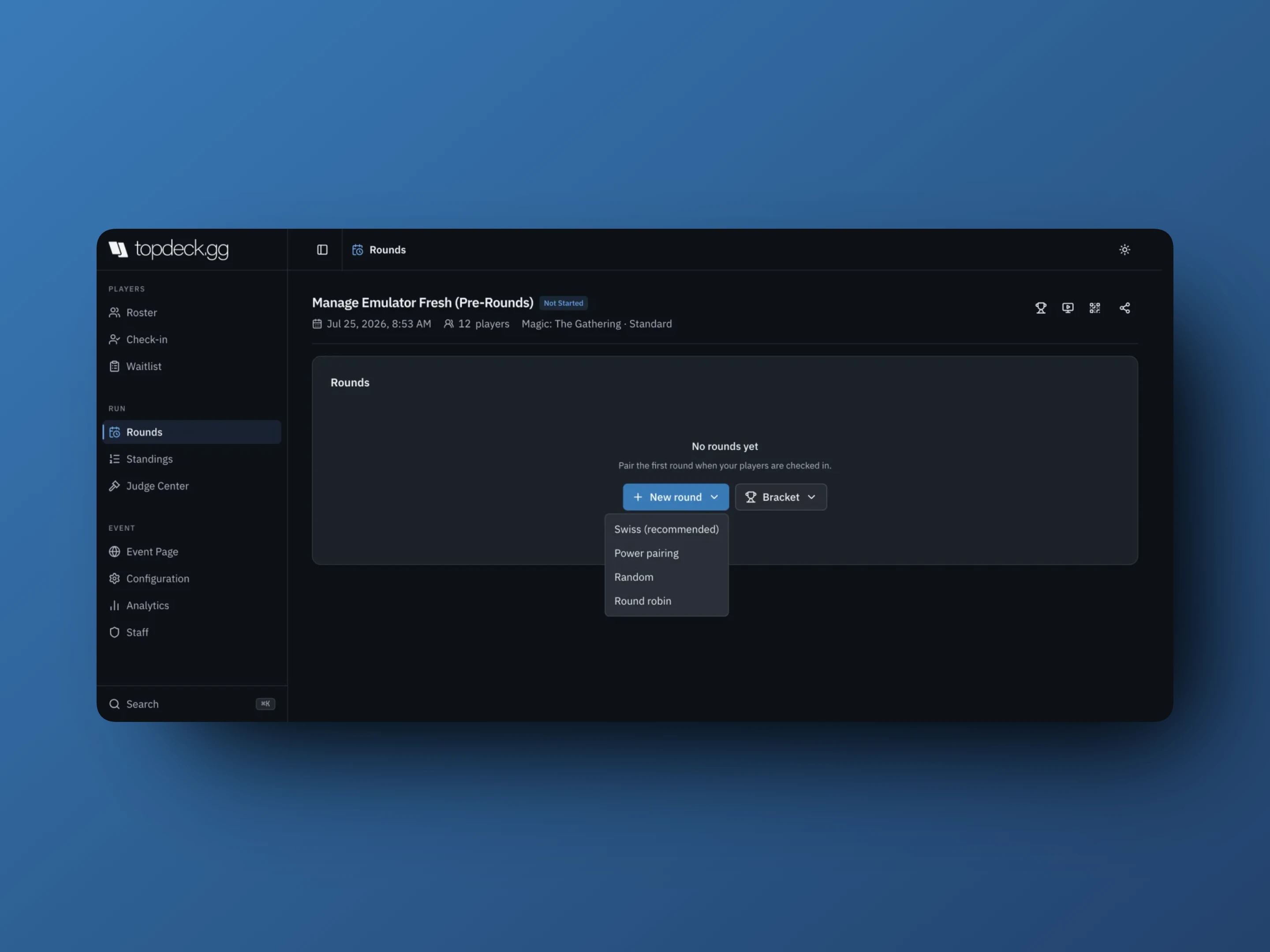
For one-versus-one events:
- Swiss (recommended) pairs players on similar records and avoids rematches.
- Power pairing pairs strictly from the top of the standings down. Useful for a final round.
- Random ignores records entirely.
- Round robin schedules every player against every other player.
- True Swiss and Recycle round robin appear where the format allows them.
For multiplayer formats the same menu offers Swiss pods (recommended), Power pods, Random pods, and Bubble pods. See Running Commander events.
Team events pair teams rather than players, which can produce several tables per match. See Running team events.
Pooled events pair by the Within pools / Between pools switch beside the menus — see Pool play below.
A freshly paired round is marked Draft — not visible to players.
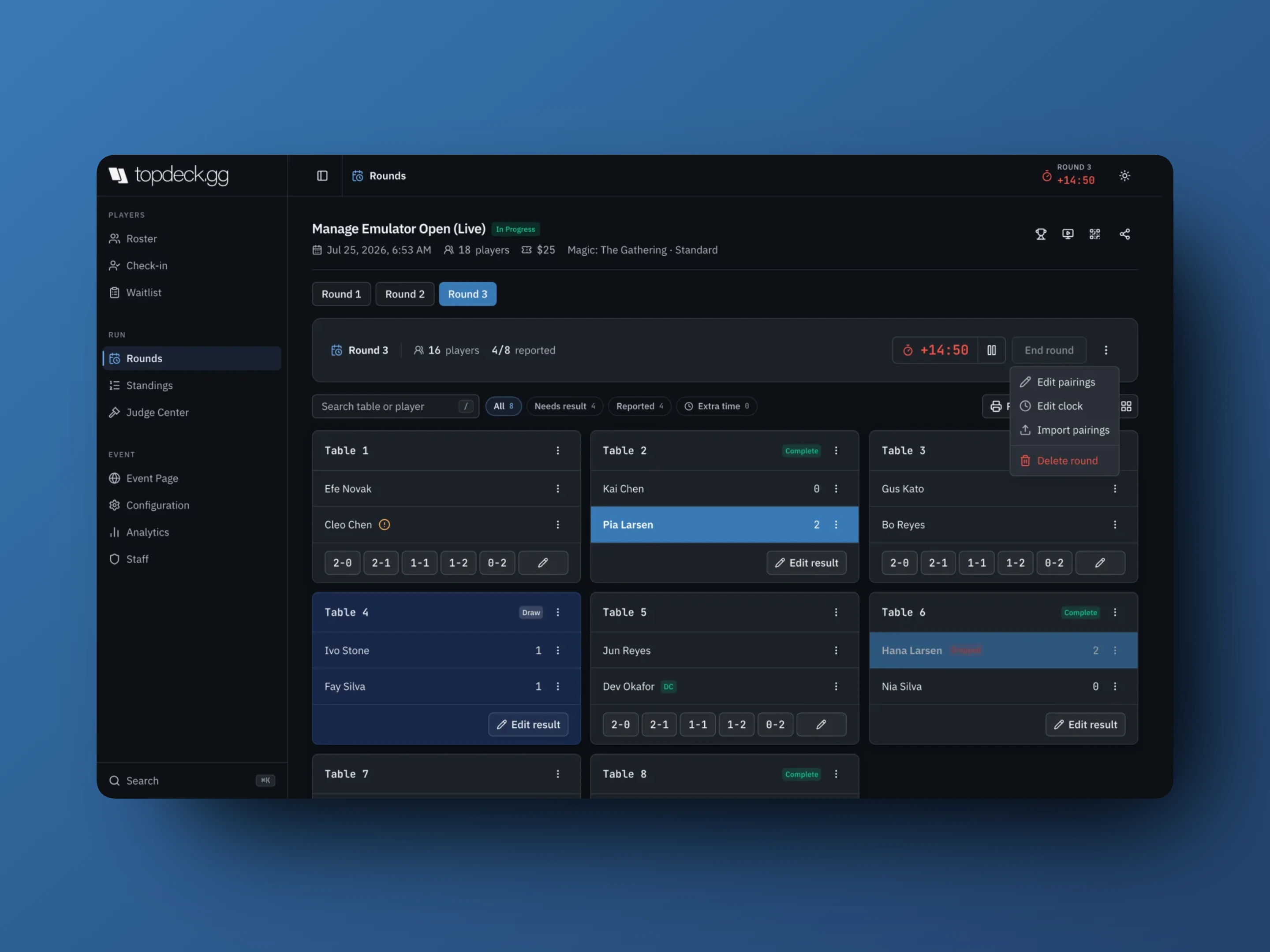
The round's ⋮ Round actions menu holds the four things that change the round itself: Edit pairings, Edit clock, Import pairings, and Delete round.
Draft and deck-building events
A draft event does not start at round one. It starts at the table, and the software walks the room through it:
- Build pods seats everyone for the draft. Edit tables moves people before you publish.
- Publish, then Start draft. The clock runs on Draft Duration (minutes) from Configuration.
- End draft closes the draft and moves on to deck building, timed by Deck Build Duration (minutes).
- Start deck building, then End build & pair Round 1 when the room is ready to play.
Sealed events skip the draft half and open straight at deck building. Draft Pod Size sets how many players sit at each draft table, independently of how round one pairs.
Import pairings from another system
If your pairings come from somewhere else, Round actions → Import pairings takes them as a CSV rather than making you retype them.
The dialog reconciles the file against your roster before it changes anything, and shows you both sides:
- New players are names in the file that are not registered. Add {count} players registers them.
- Not in the file are registered players the file leaves out. Drop {count} players drops them.
- Apply pairings seats the round from the file.
- Apply results writes any results the file carries, across every table it names.
Each step is a separate button, so you can add the missing players without dropping anyone, or apply pairings without touching results. Review the two lists before you commit: the drop side is the one that bites.
Pool play
Pools split the field into groups that play among themselves — group stages, flights, day-one brackets. One-versus-one and multiplayer events both support them.
Pool builder sits beside New round before any rounds exist and adds the pool stage. Fill it either way:
- Automatic pools takes a Players per pool number, previews the split before creating anything (27 players make 3 pools of 8, plus one pool of 3), and deals shuffled pools. Re-running it replaces the previous build.
- Build pools opens the seating editor to place players by hand.
Submit locks the build in and hands over to pairing. It warns first when active players are outside every pool or a pool is too small to play, and those warnings stay on the panel afterwards — a late registration that lands outside the pools is never silent. Reopen Build pools to add them; the next round you pair picks the change up.
Added a pool stage by mistake? The panel's ⋮ menu has Remove pool stage until rounds pair from it.
Pairing with pools
Once pools are submitted, a Within pools / Between pools switch appears beside the pairing menus, and every round and cut follows it:
- Within pools pairs each pool separately: Swiss, Round robin (each pool runs its own full rotation, with byes rotating in odd pools), or pod rounds in multiplayer formats.
- Between pools treats every pooled player as one field — crossover rounds, or the combined cut below.
Players outside every pool are not paired by pool rounds in either mode; the Pools panel keeps count of them.
Cutting with pools
The Bracket menu reads the same switch:
- Within pools cuts each pool separately and crowns one winner per pool. One-versus-one cuts must be power-of-two single elimination (Top 2, 4, 8…) with every pool holding at least that many active players. Multiplayer cuts are Top 4 — one final pod per pool.
- Between pools seats one bracket from the combined standings. Pools of 8, Swiss within pools, then a combined Top 8 is the classic shape. Double elimination needs every active player in a pool.
Sizes the pools cannot seat simply don't appear. Cutting straight from pools with no ranked rounds in between must take each pool whole — there are no standings yet to pick a top half by.
Make cut on Standings follows the pool filter: filter to one pool and a rank cut reads that pool's own ranks, so advance the top 2 of Pool 3 is a single act.
Pool standings
Standings gains a pool filter (All pools, one entry per pool, Unpooled) and a Pool column. Selecting a pool renumbers ranks within it, and print and export follow the filter. The public bracket page carries the same filter and column, so players can watch their own pool race.
Publish, then start
Publish makes the round visible on the bracket page and in the app, and notifies players of their table and seat. Hide round takes it back out of view.
Start begins the clock. Result entry opens at the same time.
Publishing and starting are separate on purpose: you can publish pairings while players are still finding their seats, then start the clock when the room is actually ready.
Run the clock
The clock sits in the round header and in the top bar.
- Pause clock and Resume clock stop and restart it for the whole room.
- Set clock / Edit clock takes minutes and seconds and rewrites the remaining time.
- A red clock with a leading plus (
+12:29) means the round has run past its length. That is not an error; it is how long the room has been over.
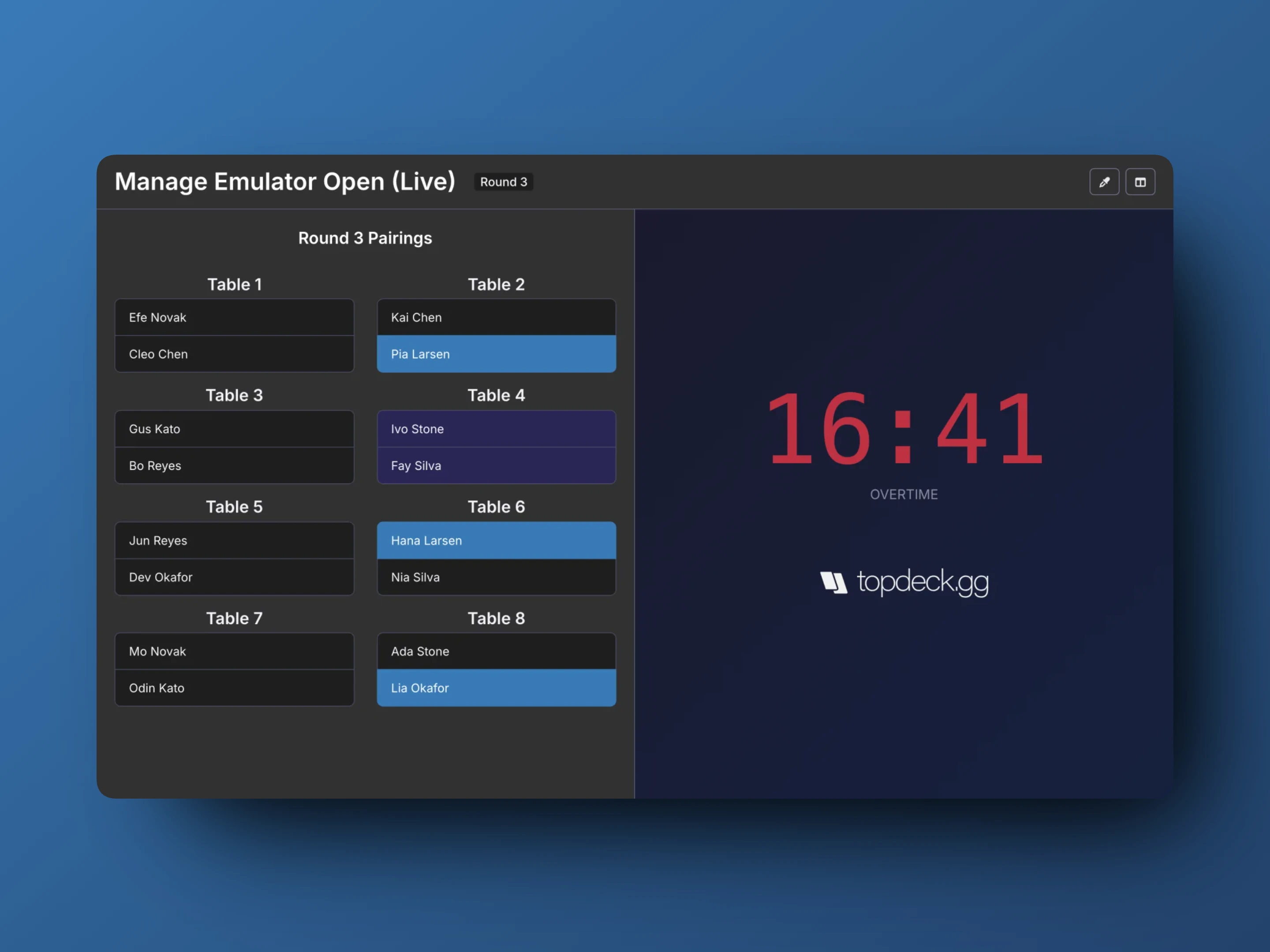
Select the display icon in the event header to Open timer display on a projector or venue screen. It shows the round clock, in red and marked Overtime once the round runs long, alongside the round's pairings and a QR code to the bracket.
Two controls sit in its top right: one collapses the pairings panel to show the clock alone, and one opens Timer Customization for the background and text colours, so the screen can match your venue or stream overlay.
Games that have leaders or legends, such as Riftbound, add a crown icon beside it for the Leader tracker. That is a staff-only board of how each leader is performing across the event, useful for a "best of leader" prize or for coverage. Events in games without leaders do not show it.
Enter results
Every table card has quick-result buttons built from the event's Best Of:
- Best of 3 gives
2-0,2-1,1-1,1-2,0-2. - Best of 1 gives
1-0, Draw,0-1.
The pencil button opens Custom result for anything else. Points-mode events get a points field per player instead of win counts.
Enter a whole round without touching the mouse
Type a table number. That is the whole gesture: there is no mode to turn on and nothing to click into first. Digits are picked up anywhere on the board, as long as you are not already typing in a field, a dialog, or a menu.
A readout appears at the bottom of the screen while you type, showing the number so far and who is sitting at that table, so you can confirm you have the right one before you commit to it. If nothing matches, it says No table 37 instead.
- Enter jumps to that table and puts the focus straight on its result entry.
- Left and right move along the result buttons; up and down move between the seats.
- Backspace fixes a mistyped digit. Escape clears what you have typed, and Escape again steps back out to the board.
- The number clears itself after a few seconds if you get pulled away mid-entry.
The number you type is the one printed on the card, so a custom Starting Table Number and any Blocked Tables are already accounted for. You never translate between what the room calls a table and what the software calls it.
Once you have the rhythm, a round of sixteen tables is: number, Enter, arrow, Enter. No mouse, no scrolling, eyes on the slip rather than the screen.
Two other ways to move around the board:
- Press
/to focus the search box, which matches both table numbers and player names. - Switch between Card view and Grid view with the button beside Export.
When self-reporting is on, players' submissions land on the same round marked Self-reported. Staff can confirm, dispute, or overwrite them. Edit result changes a reported table; Reset result returns it to unplayed.
Find the tables that matter
The filter chips above the tables carry live counts:
- All
- Needs result
- Reported
- Extra time
Needs result is the one to work from at the end of a round.
Table actions
Open a table's ⋮ menu for table-level work.
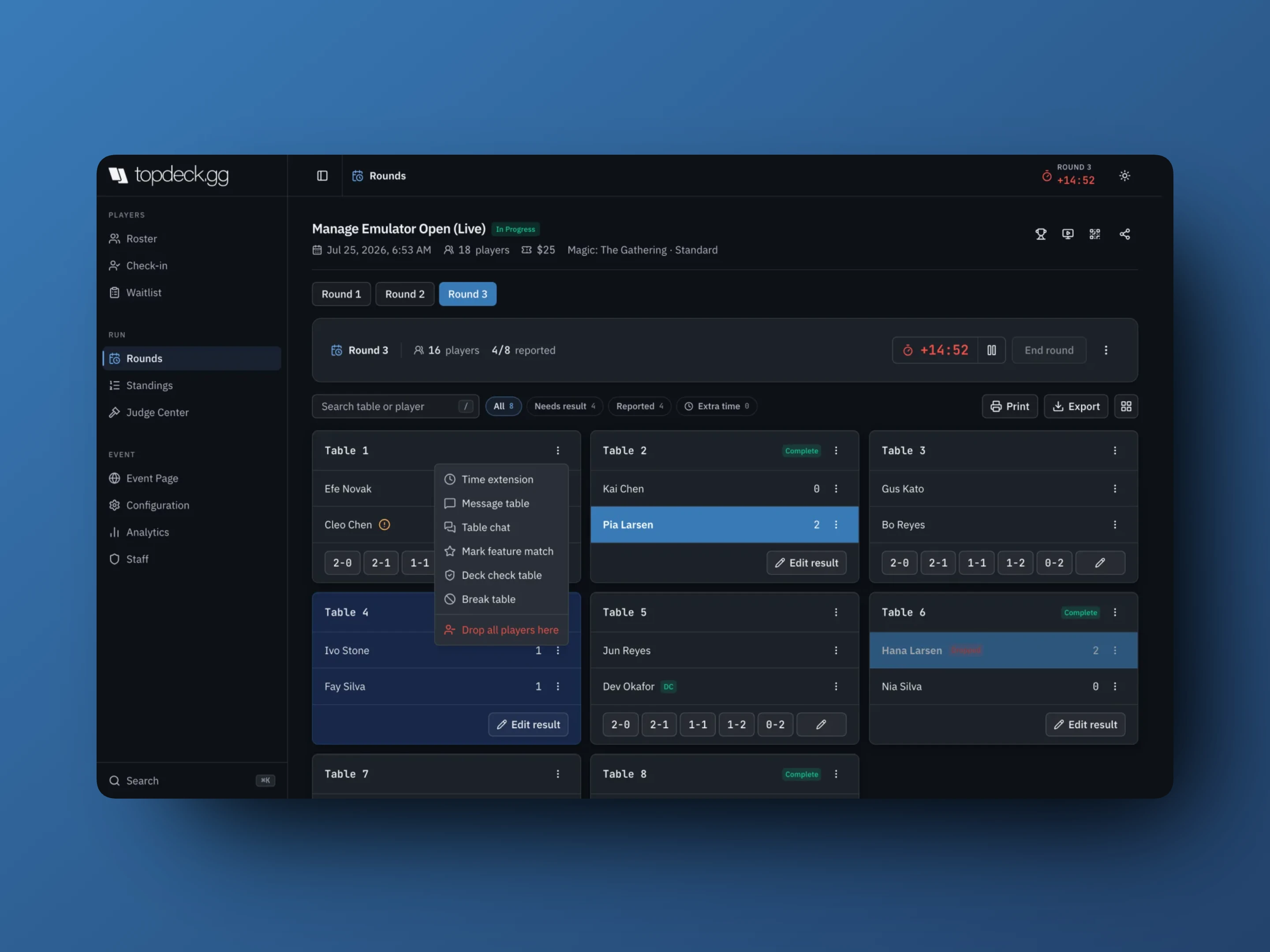
- Time extension takes whole minutes and shows
+5mon the card. Extended tables appear under the Extra time filter. - Message table sends a push notification to everyone seated there. It offers three ready-made messages so you are not typing the same thing forty times a day: Please report your match result, Please come to the judge table, and You are the feature match! Please come to the feature match area. Custom message covers the rest.
- Table chat opens the table's conversation.
- Mark feature match flags the table for coverage.
- Deck check table marks every seat deck-checked; Unmark deck check reverses it.
- Break table removes the table from scoring.
- Drop all players here / Undrop all players here handles a whole table at once.
- Reset clears the reported result.
Player actions at a seat
Each seat has its own ⋮ menu:
- Player details opens their event record: standing, match history, penalties, decklist, team.
- View decklist / Add decklist
- Mark deck check / Remove deck check
- Add penalty
- Assign game loss / Unassign game loss applies to the next round you pair, not the current one. To give a game loss now, enter it as the result.
- Make new winner on a reported table
- Drop player / Undrop player
- View profile
Fix a round
Round actions → Edit pairings opens the seating editor.
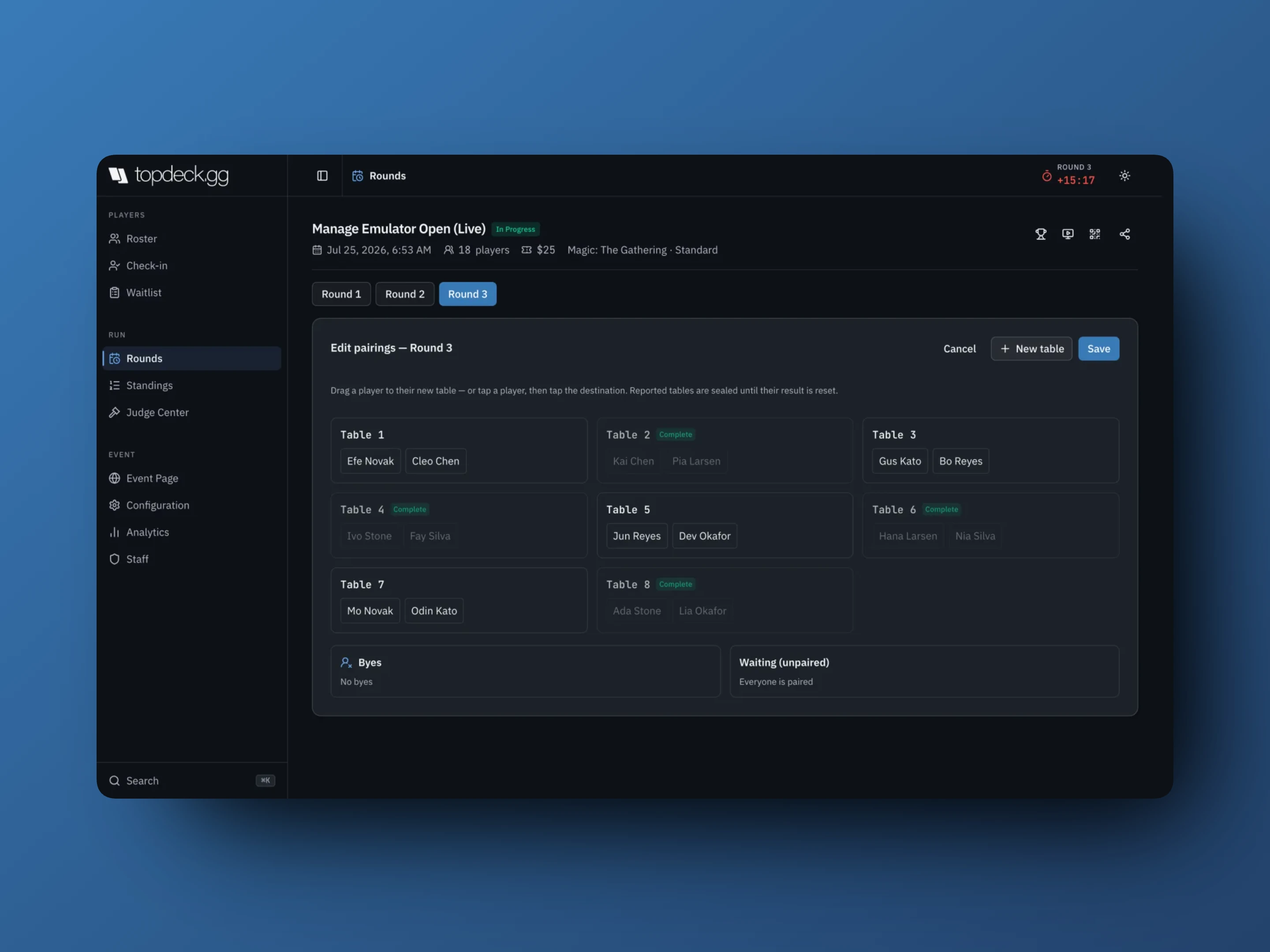
- Drag a player to another table, to Byes, or to Waiting (unpaired).
- New table asks for a table number and creates it.
- A table marked Complete is sealed. Reset its result first.
- Each table needs exactly two players or none.
- Save publishes the new seating immediately.
To remove a no-show mid-round, move them to Waiting (unpaired), then drop them.
Round actions → Delete round removes that round's pairings and results, and refunds any manual byes and game losses it consumed. Deleting is not reversible.
You can also edit a finished round at any time: select its round tab, reset the affected table, and enter the corrected result. Standings recompute immediately, so there is no need to rebuild later rounds. The same is true of scoring values and tiebreakers: change them in Configuration and every standing re-grades against the new settings.
Make the smallest correction that matches what happened in the room. Do not rebuild a round to fix one table.
Print and export
Print offers:
- Match slips print one slip per table with seats, a winner line, and drop boxes.
- Seating sheet prints the field in alphabetical order with table and seat.
Export downloads the round or standings as CSV, named with the event and date.
End the round
End round stays disabled while any table is missing a result. Work the Needs result filter until it clears, then end the round.
Open Standings to check ranks and tiebreakers before pairing again.
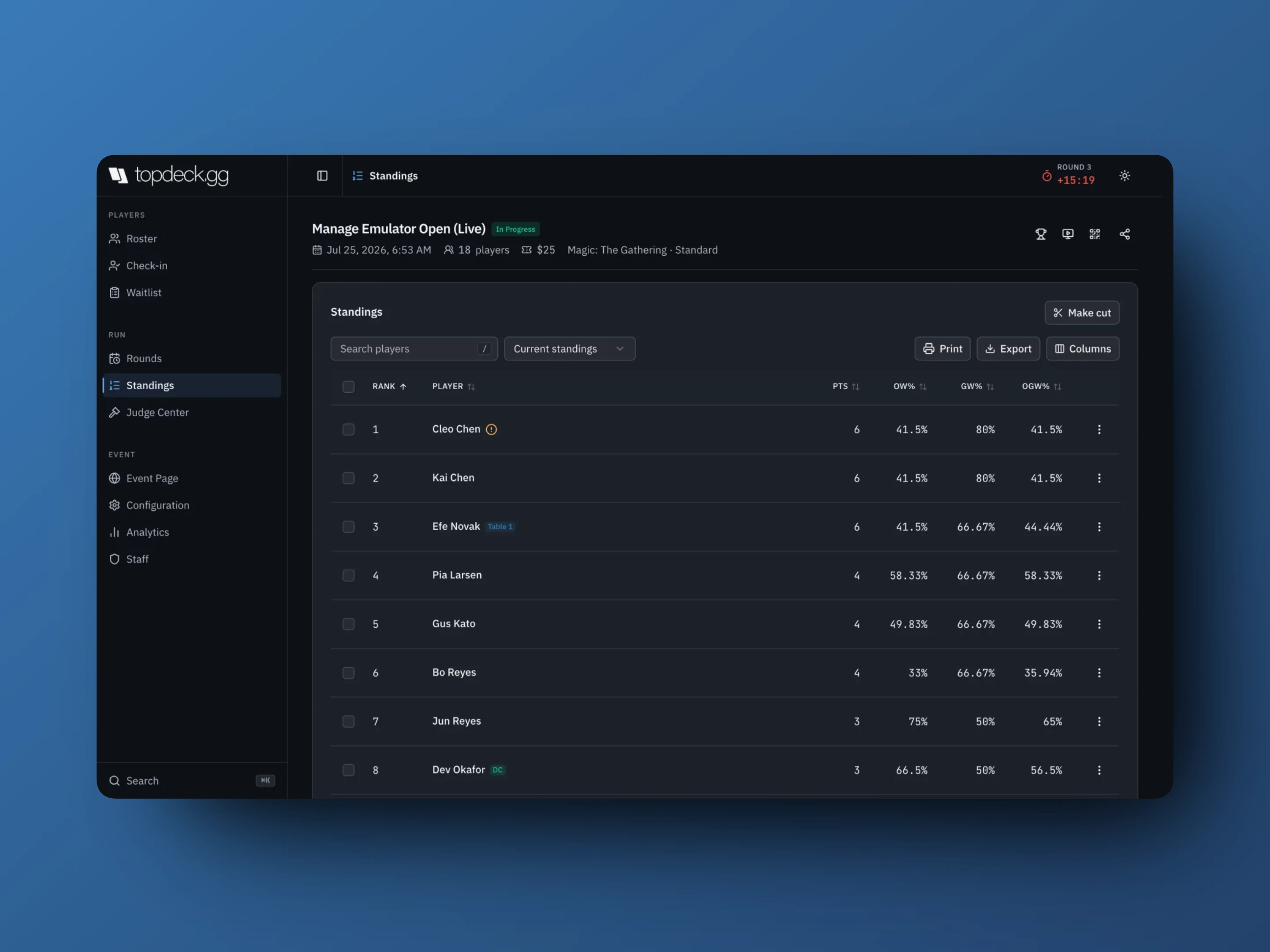
Standings row menus carry the same player actions as the round page, plus Assign round bye, Lock to table, and Send message. Drop log lists who dropped and when.
Cut to a bracket
Two steps, and you can use either or both.
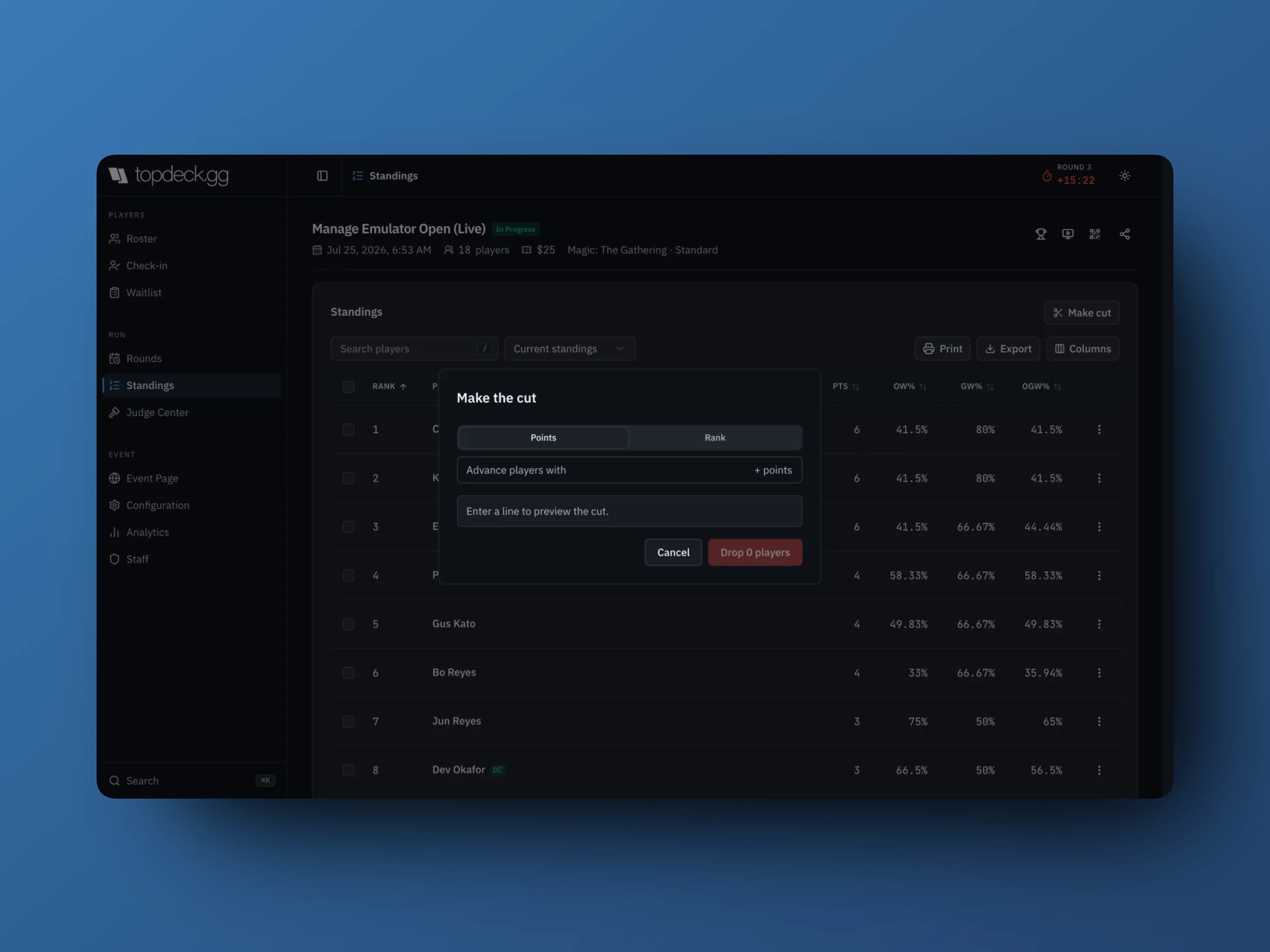
Standings → Make cut decides who continues. Choose Points or Rank, enter the line, and the dialog previews the cut before you confirm. Confirming drops everyone below the line, and the button names the number, for example Drop 12 players.
Bracket creates the elimination stage.
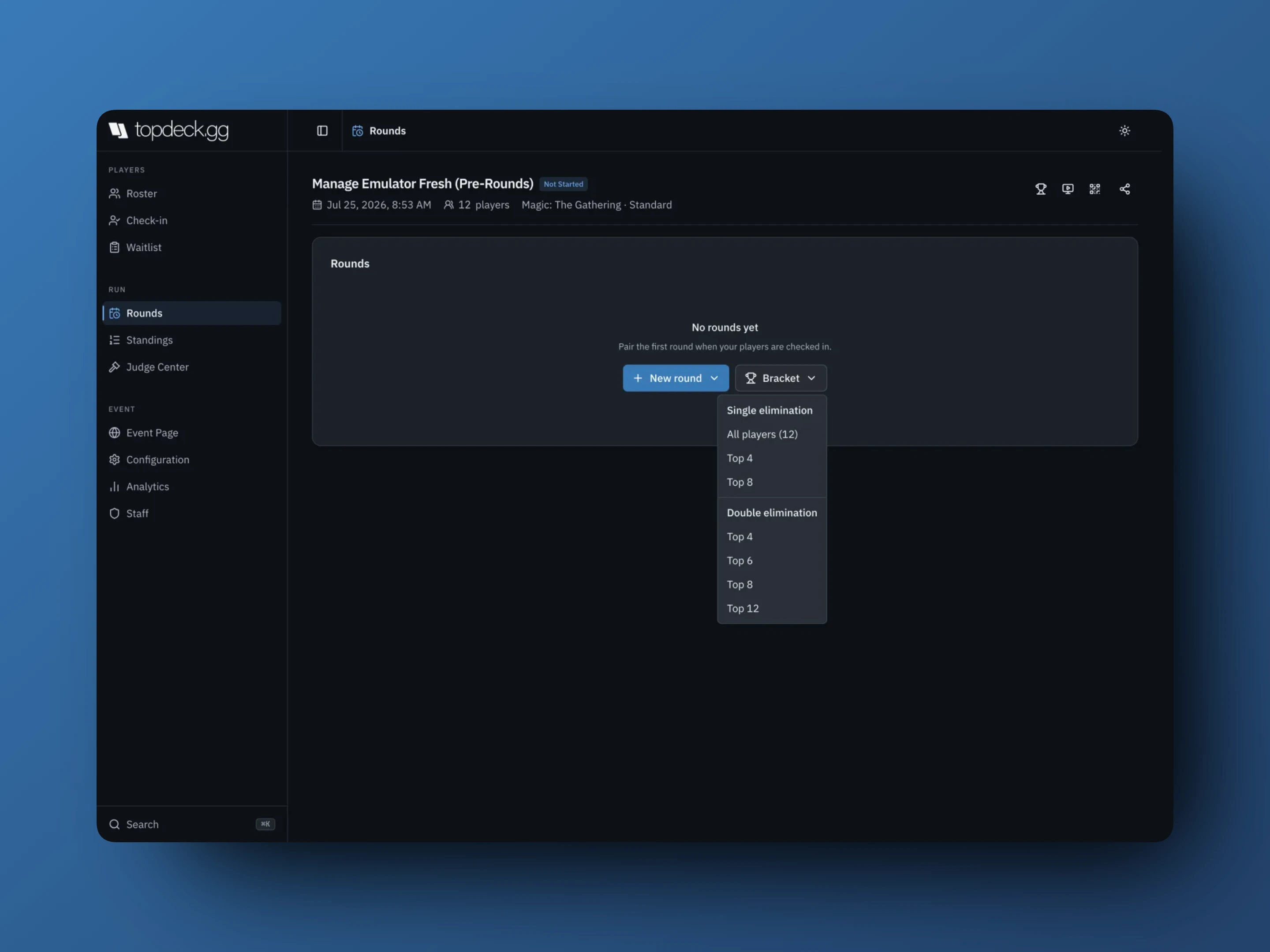
- Single elimination: Top 4, 8, 12, 16, 32, 64, plus All players.
- Double elimination: Top 4, 6, 8, 12, 16, 24, 32, 48, 64.
- Multiplayer events cut to pods instead, at Top 4, 7, 10, 13, 16, 40, 64.
Bracket rounds are labelled by their stage (Top 12, Winners semifinals, Losers finals, Grand finals), and byes to the next power of two appear on their own card.
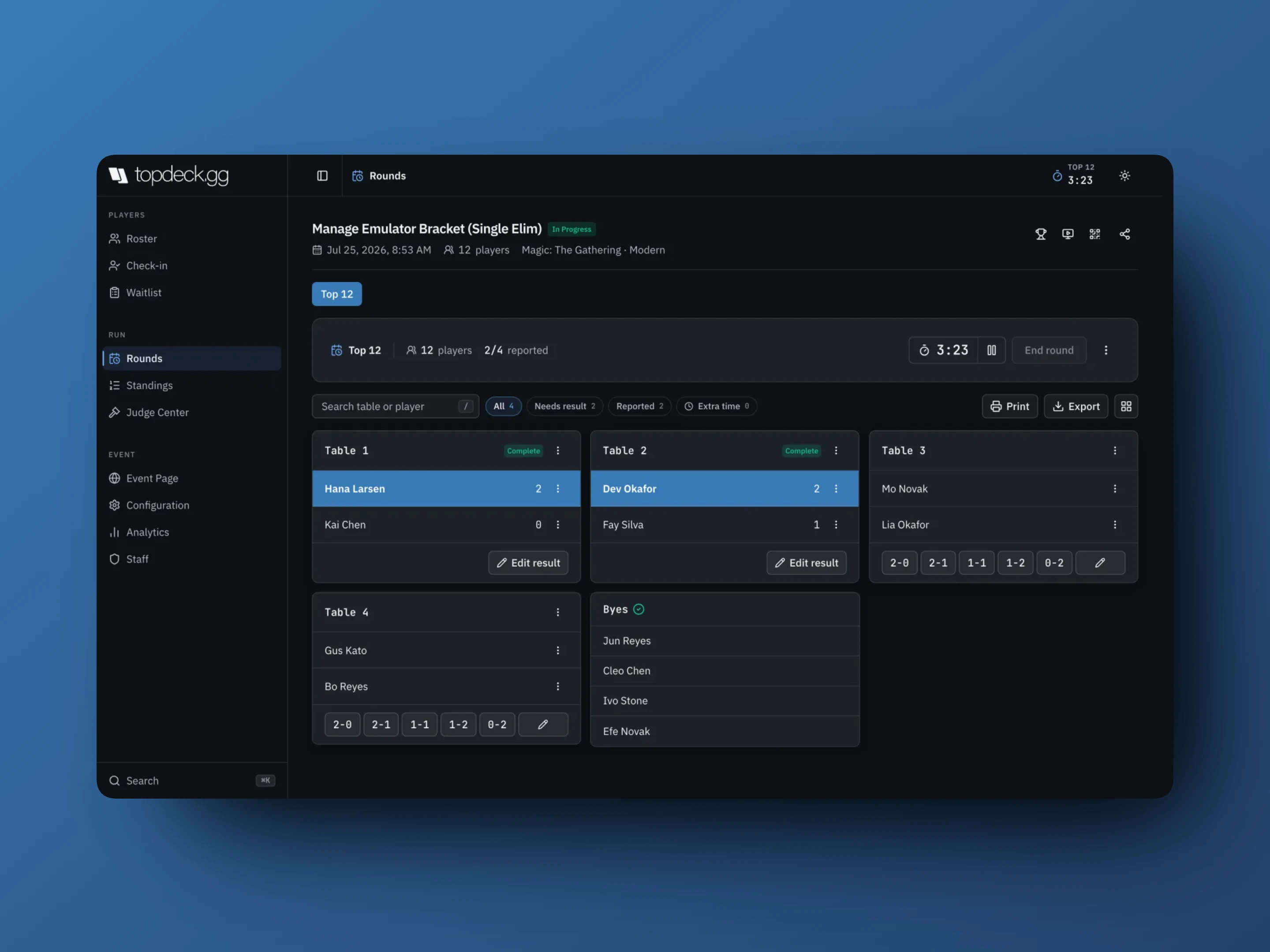
Advance bracket moves to the next bracket round once its results are in.
Finish the event
- Resolve the last table.
- Check final standings, drops, penalties, and deck checks.
- Select End tournament in the bar below the tables.
- Export whatever your game or organization requires.
End tournament only appears once every table is certified, and it stays hidden while a bracket still has rounds to advance, so you cannot finalize half a Top 8 by accident. It needs Scorekeeper access: a head judge can pair and advance rounds but cannot end the event.
Ending publishes final results to the event's public pages and player profiles, and feeds any circuit leaderboard the event belongs to. Reopen tournament undoes it if you ended early by mistake.
If the network drops
The manager watches both the browser connection and the live tournament data. When the server is unreachable, an Offline badge appears in the top bar with a count of queued actions, and the event keeps running against the local engine. You can still pair, publish, and report.
- Keep the event in one operating tab. A second tab queues its own copy of the work.
- Players see nothing new while you are offline. Use Print to get pairings and standings into the room.
- On reconnect the queue replays in order and reports Back online — N synced.
- Retry sync re-sends after a failure. Discard throws the local queue away without sending it, and asks Sure? first.
If the manager reports Unsynced changes from a previous session, check the event's current state before choosing. Retry sends held actions that may already be stale; Discard drops them.